
As I return from yet another excellent Coppieters Foundation event in Brussels, representing Women for Independence, I am so struck by the huge variation in the lives of women across Europe (and beyond) that sometimes it amazes me that any sort of unifying theory such as feminism could exist.
To be true, feminism is a broad church, with many faces and phases, and sadly in recent times it’s not been unified at all but in some places and in some subjects is eating itself. I always wonder why people don’t appreciate who benefits when the women’s movement attacks itself. Well, it’s the patriarchy, isn’t it? Something perhaps to ponder on.
The multi-faceted approaches and experiences of feminism from several standpoints was the subject of feminism from the periphery. This is where we can see the importance of intersectionality and its role in feminism – and perhaps more importantly, the risks to advancing equality, if it’s not adopted at policy levels. It also demonstrates how where we come from and the spaces we inhabit as people impact on our understanding of feminism, and our experiences of it. I would revisit my theory of the role feminism needs to play in national self-determination movements and the impact of such movements on feminism.
On that latter point, I should concede that it has not been an easy relationship. When self-determination movements adopted (as they did in many places) a narrow 19th century version of nationalism (about as far away from civic nationalism as it’s possible to get), very often they consigned women to mere breeding mares for the new nation states that were dreamt up. Often couched in terms of cultural nationalism; the very traditional role of women (for example, in Breton society) was simply re-enforced in the cultural nationalism that developed there from the thirties and women found it hard to join the feminist debates in the first and second wave.
Closer to home, Irish Republican women of a certain age rejected (and some still do) the label of feminist, preferring to be defined as Irish Republican women primarily. As that is the struggle that is, for them, the most important and the most pressing. The reasons for this are unclear, it may have been that the feminist movement in the seventies, as The Troubles erupted, were less than sympathetic with the struggle being fought in the North of Ireland. There simply may not have been shared values. And we must not forget the legacy of a male-dominated Ireland, especially in the narrative of Republican struggle terms. Young Irish Republican women, I am happy to report, appear to see no such conflicts of interest.
And for those feminists (often found lurking in our higher educational establishments) who prefer a Marxist interpretation of feminist theory, they tend to follow the fear and loathing that Marx did of all things nationalistic. He did not see it as a revolution worth supporting, just another way of keeping power in smaller units and not for the benefit of the many. 19th century nationalism was certainly marked by military actions, invasions, wars, and to a large degree, a great deal of violence to women as collateral damage. To these feminists, therefore, my assertion – often made and often written about – that self-determination is a feminist issue, does not sit comfortably. But then, my arguments are strong, if we shift focus slightly, and it would not do if we were all the same, now, would it?
So, let us look at that assertion before we go on to look at the need for intersectionality and how that might be the next important thing for women. Stop me if you have heard what follows (or skip a paragraph or two)!!
In the simplest analysis, because women make up most of the world’s population; there is nothing in politics, economics, civil society, culture, or creativity which is NOT a feminist issue and that cannot be seen – and indeed should be seen – through a gendered perspective.
After centuries of the patriarchy, women’s experience of the world in all these spheres is vastly different from men. Therefore, what women think needs changed and what women want to see changed is also vastly different.
If you think of some of the reasons that drive self-determination movements, they are broadly:
- A desire to change the status quo
- A desire to replace an old order and way of doing things that is no longer fit for purpose
- A demand to change the balance of power
- An attempt to turn back mistakes of history
A history, mind, that women played no part in, had no say about and certainly didn’t vote for.
If we accept that women had little role, if any, in creating the historical contexts in which nation states have developed, but we also accept that self-determination offers the potential for a new beginning and the opportunity to form a country anew, with different priorities, different emphasis and a complete break with the past, then self-determination provides the potential to make sure that women’s voices and interests are given a fair consideration on that journey – at last. And I use the term self-determination or independence in favour of nationalism which in some parts of Europe – and a mischievous British media – still has ghastly right-wing connotations of the 19th century kind.
Women for Independence was formed in the belief that ONLY Independence will give us the full powers to drive the aims of a socially just nation, which have been denied us through political policies from Westminster we have not voted for and a lack of power to implement the changes we want to see. (We REALLY should get that on a t-shirt!!) The sorts of powers which would promote the rights and roles of women and girls and are the best feasible way to realise the hopes and dreams of ourselves, our families and our communities. In areas like social welfare, childcare, caring responsibilities and the roles of carers, a commitment to fairer work, breaking down market segregation in the labour market, equal pay, radically changing how poverty is addressed by fully understanding what drives it and how it adversely affects women more, more suitable transport and energy policies, and real progress on Violence Against Women and Girls.
If we think of self-determination, as always, a question and opportunity for national sovereignty to be addressed as an issue of social change, then we can see how it fits a feminist narrative. Changing the status quo, turning back the clock, shifting the power paradigms and resetting the clock on systems of government, rules and power, that are no longer fit for purpose. Isn’t this Feminism 101?
I wrote recently about the importance for women not just in the end goal, but in the journey to Independence and how social movements and players like WFI are intrinsically more democratic than political parties and are designed to give more actors and different voices at that, their voice. Self-determination which puts social justice and human rights at its heart benefits women the most, because they still have the furthest to come in both contexts. And we know that poorer women, women who live in rural communities, disabled women and women of colour have even further to come, too.
And so, just to rattle the cages a bit again, I’ll also restate my view that a real commitment to democracy cannot be said to exist without a vibrant social movement and a mobilised civil society. Social movements should be celebrated, not criticised, for their ability to disrupt the relationships between different power holders. And in disrupting and challenging those power dynamics and these hidden power roles, social movements which champion self-determination are the natural home of women in all our variations and of feminism. Convinced? Good!
So, what about intersectionality? Well, it’s all linked. And the link, dear reader….is POWER.

Intersectionality is the idea that distinct factors such as gender, race, disability, immigration status, sexuality are not separate single issues but interconnected forms of injustice – creating distinct experiences of privilege and oppression. These intersections matter and have real consequences in the day-to-day lives of people. Let us consider Poverty, which is a focus for WFI just now, with our #livingshouldnotcomeatacost campaign.
The impact of poverty is as varied as the millions who live in it. No two people have the same experience. But we know that women suffer from poverty and the political decisions that create it, such as austerity, to a much greater degree than men. We should also know by now that austerity is a political strategy; is political power playing and is NOT an inevitable course of action; it is a political choice. AND because the vast majority of politicians are not women living in poverty or women of colour or disabled women, single parents and all the combinations thereof, AND because people from within these demographics are less likely to be political engaged, then these political decisions will continue to be made without any understanding of their impacts and therefore even less understanding of how to mitigate the impacts.
Structural inequalities – gender, race or ethnicity, disability and nationality or migration status – have intrinsic connections to economic disadvantage. These factors shape how wealth and prosperity is shared in societies, and how and where poverty is concentrated. A woman of colour may have a distinct experience of workplace discrimination, or a disabled person could face unique barriers to adequate health care, both of which could have consequences for their economic security. Asylum women in Scotland are facing a greater crisis of food insecurity. The existence of No Recourse to Public Funds in the UK for certain classes of migrants and immigration statuses means access to public services including social housing is denied. Access to health services when you are not a native language speaker is harder, as is understanding and navigating your way round the benefits system.
To tackle this, to better understand how structures and systems of power and oppression such as racism, sexism and ableism shape experiences, opportunities, and outcomes in our society, we can begin to design more effective interventions to redistribute power – because at its heart, Intersectionality is about redressing the power balance and uncovering secret power relationships.
And reshaping where the power lies is essential for women if we are going to smash the patriarchy – which we should all be doing at least every Tuesday if not all the time. But I get it, we are busy!!
But seriously unequal power relations are a key driver of poverty, and a lack of power is central to how people experience poverty across the world.
People are NOT homogenous. Groups of people are not homogenous. Women are NOT homogenous. Recognising that there is no essential or universal experience of being a woman, or being disabled, or being from an ethnic minority is critical. Intersectionality investigates each of these categories to understand the differences within and between groups of women, within and between disabled people, or within and between minority ethnic groups.
BUT, and there is always a but, while many of us can theorise about Intersectionality the fact remains it is not yet fully understood by policy makers and in Scotland we lag far behind in its implementation. We are still too wedded to the one-size-fits-all approach when we come to the biggest markers of inequality: poverty and work. Huge national contracts are awarded to offer a uniform solution to the barriers that people – with multiple barriers – present with. This is done without fully understanding what those barriers are and how they impact, and therefore done with extraordinarily little clue about how to provide solutions.
But only by understanding the interactions between the forces that drive inequality, and how they shape the multiple identities and the social positions that people hold, will we be better positioned to make progress on reducing poverty and inequality in Scotland, including for the majority of us: Women.
The importance of taking an intersectional approach to poverty is underscored by the COVID-19 crisis. As many have observed, while we may have been weathering the same storm, we were not all in the same boat. And the pandemic is expected to deepen existing inequalities. And while the Scottish Government have been very keen to take evidence on the impact of Covid from diverse groups they have been from distinct groups. From migrants; from single parents; but where does the single mum who is a migrant give her evidence?
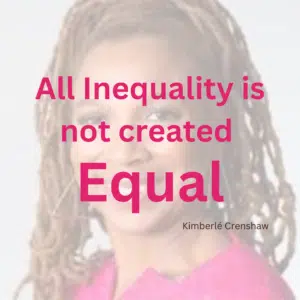
While there has been a little progress in a wider view of child poverty and gender equality there is a long way to go. Better-trained policy staff and expertise in intersectional impact assessments would be a start, but we all know how poorly Equality Impact Assessments are conducted, and they have been around for a while. Gender budgeting still struggles to get a fair hearing, so intersectional gender budgeting might be a long way off. It would help if we collected the right sort of data from groups and if we really took the lived experience of people seriously. There is a great deal of noise around co-production now, but still suspicion between policy makers and those with whom they wish to co-produce, if we are honest.
So, leading the field on intersectionality as it affects women, and all the inequalities we face, needs to be the next big power-busting role for feminists in Scotland.
Who’s in?
About the author:
Maggie Lennon is a long-standing member of WFI and has served on the the National Committee for many years. During this time she has worked on many of our major campaigns and projects, including JusticeWatch and our Womanifesto. She is the Director of The Bridges Programmes, which supports Refugees and Asylum Seekers find relevant and appropriate work placements and shadowing experiences in Glasgow. In addition to this, she is a prolific campaigner and spokeswoman for Human Rights. She gave this speech on behalf of WFI, at a Coppieters Foundation conference in Brussels. In their recent publication, she wrote a chapter on movements for self-determination and relationships with the EU.